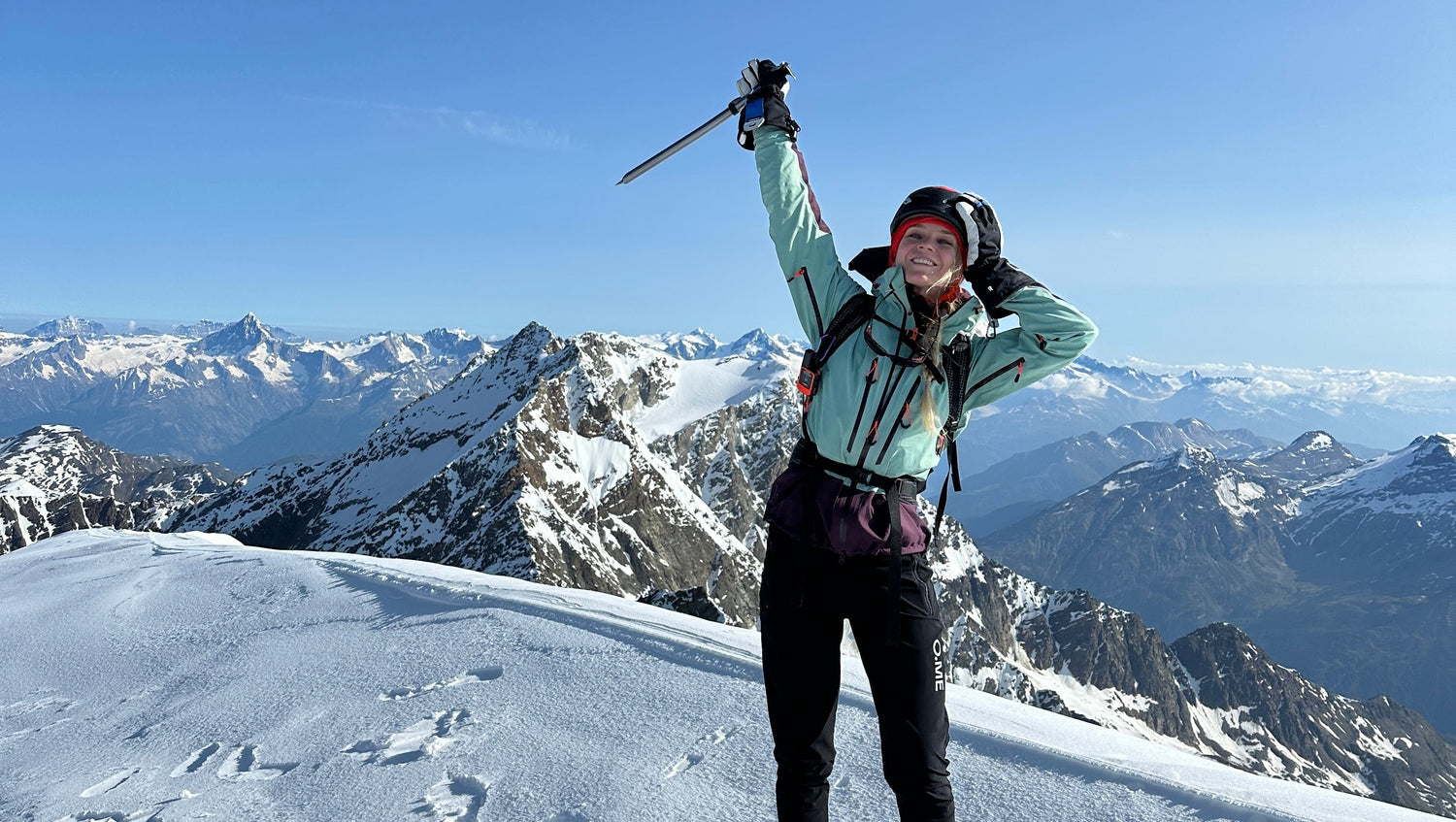
Moving in the mountains combines endurance, technique and the ability to make decisions when tired. Mountaineer and influencer Lotta Hintsa has structured her training so that mountaineering and mountain running support each other.
We spoke to Hintsa about how to train for the mountains – including in Finland, where elevation changes are modest.
1. How do mountaineering and mountain running support each other?
Hintsa sees the sports as strongly complementary.
“Both mountaineering and mountain running require strong aerobic fitness, which is why in everyday training I mainly work on the assumption that I am preparing for mountain running races.”
The fitness developed through mountain running makes climbing safer.
“Training purposefully for mountain running makes mountaineering a little safer, because on risky sections, speed means safety.”
At the same time, climbing brings technical confidence to running.
“Strong technical climbing skills support mountain running, particularly on technical terrain where you need more than two limbs. And when you have to deal with exposure in mountaineering, exposed mountain trails almost feel like child’s play.”
Hintsa’s own ‘sweet spot’ lies somewhere between the two.
“Speed ascents are perhaps the best combination for me – climbing a mountain as quickly as possible, ideally at record pace.”
2. What does a typical long training day in the mountains look like?
For Hintsa, the best training days often happen at mountain training camps.
“In addition to climbing projects, I try to spend several weeks, sometimes even a month, training in mountain conditions each year – in the Alps or the Sierra Nevada, for example.”
Long days then happen almost without noticing.
“A day often includes a three- or four-thousand-metre peak – or two. Or three.”
She welcomes plenty of elevation gain.
“There might be 1500–3000 metres of ascent and usually 15–40 kilometres or more. It can take anything from four to fifteen hours.”
3. What does moving in the mountains demand most?
According to Hintsa, endurance is an important foundation – but not the whole story.
“Good endurance buys you as much time as possible before you start needing mental toughness.”
But in the mountains, there are moments when the mind has to work too.
“And in a way, the aim is to reach that point where mental toughness is needed regularly.”
4. How do you structure your training for the mountains?
Her everyday training is built strongly around endurance.
“Most of my basic training outside training camps consists of long aerobic sessions: trail running, cycling, or using the treadmill and stair climber at the gym.”
Training changes with the season.
“Depending on the training phase, I focus either on threshold endurance or speed.”
Most key sessions, however, involve running.
“I almost always do my threshold and speed sessions by running.”
Her programme also includes two strength sessions a week.
“Strength training focuses on my legs and core, while climbing sessions provide the stimulus for my upper body.”
5. How do you develop climbing strength for long ascents?
Hintsa makes no secret of her preference for one form of training.
“I love running uphill on a treadmill.”
She says threshold sessions in particular work well this way.
“One fairly standard session, for example, is running uphill for 3 × 35 minutes, with five-minute recoveries.”
Another important tool is the stair climber.
“Relentlessly grinding away on the stair climber for 3–5 hours at a time, sometimes several times a week, builds a good base and spares the legs some impact.”
The machines cannot replace downhill running, however.
“That is why strength training is important – so that the stabilising muscles can cope with descents too.”
6. Can you train for the mountains in southern Finland?
Hintsa says you can – by focusing on the right things.
“Developing aerobic fitness is a good starting point. Days in the mountains are long and sometimes unpredictable, so good endurance fitness is also a safety factor.”
Strength training helps prevent injuries.
“Strengthening the lower body and core helps a lot.”
You can practise the technical side through climbing.
“If you are interested in more technical climbing, it is worth going to climbing gyms and outdoor crags.”
The Finnish winter is useful too.
“Understanding different types of snow and ice helps in the mountains – that is where I have noticed the benefit of being Finnish.”
7. How can you simulate long ascents on flat terrain?
At this point, Hintsa laughs a little.
“Unfortunately, the best way to simulate long ascents is on a stair climber at the gym.”
Treadmill inclines are not always steep enough.
“If we are talking about actual mountaineering, treadmill inclines are often too gentle. They are enough for mountain running, though.”
Finnish hills do have one advantage, however.
“Uphill sessions are often short, but you get downhill training alongside them – and the surroundings are usually more pleasant than a gym wall.”
8. How important are long training days?
Hintsa’s answer is clear.
“Extremely important.”
Days in the mountains are almost always long.
“Simply knowing that you can get through a long day without problems is absolutely essential.”
She says long sessions are one of the most important forms of preparation.
“And you can do them anywhere in the world.”
9. How do you look after your energy intake on long training sessions?
Energy intake was not always a priority in mountaineering culture.
“For a long time, the mountaineering world had a strong ‘tough it out’ mentality – the idea that you should not have to depend on energy even in training.”
This did not work for Hintsa.
“I often struggled with injuries and my progress stalled, so I started working with a dietitian.”
These days, her energy intake is planned.
“I focus particularly on carbohydrate intake during training.”
In practice, a drink is one of the easiest ways.
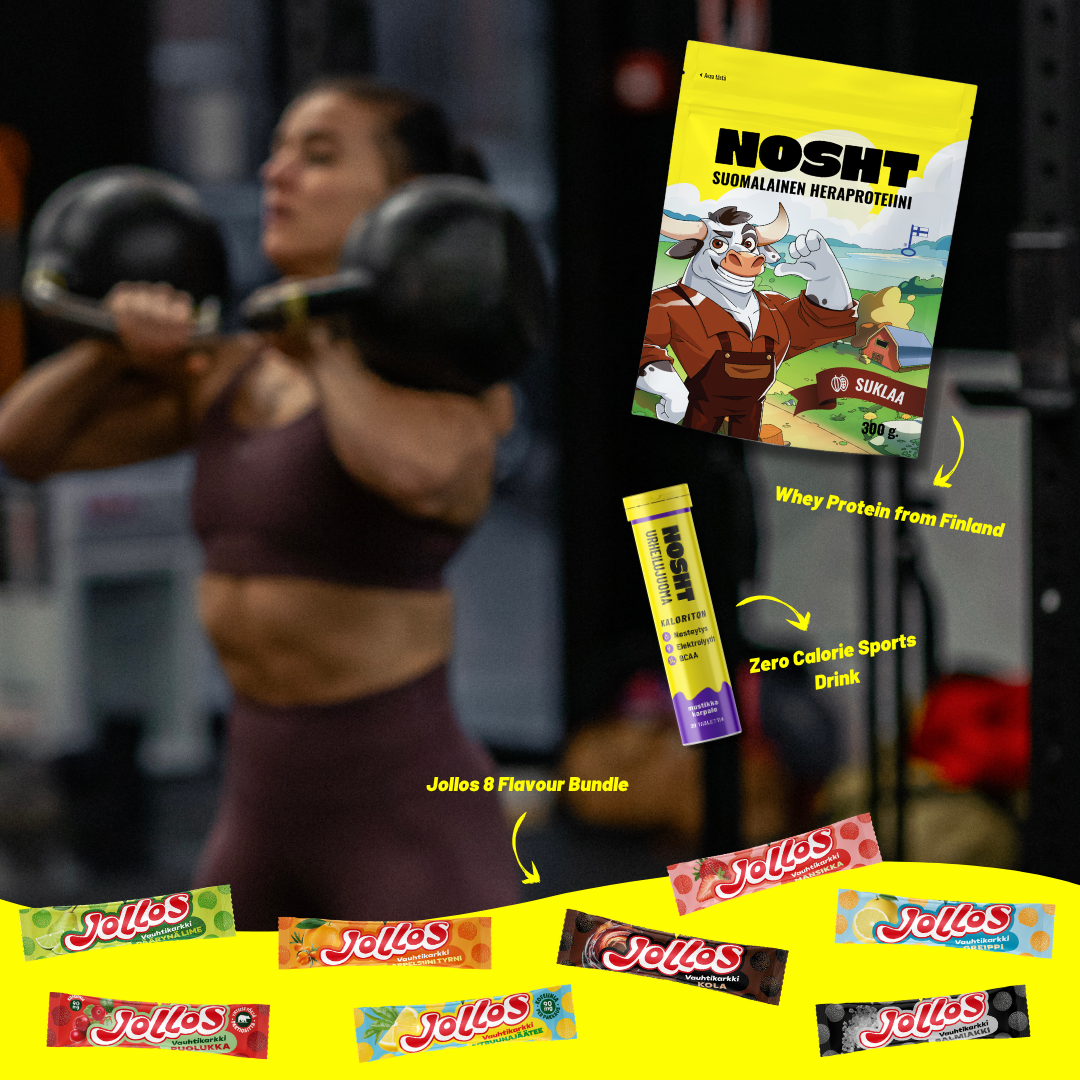
“For me, mixing Nosht sports drink into part of my drinking water has been an easy way to get enough energy and fluids.”
She takes additional energy products too.
“Using Jollos Energy Chews makes it easy to keep track of the amount of carbohydrates consumed.”
On very long sessions, she takes other food as well.
“If a session lasts more than four hours, I want something savoury and try to get a little protein too.”
Recovery starts straight after training.
“You need protein and carbohydrates as soon as training finishes – Nosht’s Palkkari is a bit of a no-brainer for that.”
10. What is your most important advice for someone in Finland who dreams of the mountains?
According to Hintsa, you do not have to start in the mountains with huge ambitions.
“Good aerobic fitness and adequate leg strength already provide a solid foundation for mountaineering.”
It is worth building technical skills gradually.
“Add rock climbing to that and you can get to know the technical side of mountaineering.”
The most important thing is to progress one step at a time.
“When you start booking climbing trips, begin with easier mountains and add elements one at a time – technical difficulty, elevation gain, altitude, length of day and pack weight.”
This builds experience that will serve you well.
“That is the best way to learn to be an independent climber who can take responsibility for themselves in the mountains and climb on the mountain’s terms.”
Pick up Lotta’s favourite products here: